Vine Status
We received much-needed rain (~0.9 inches) yesterday!
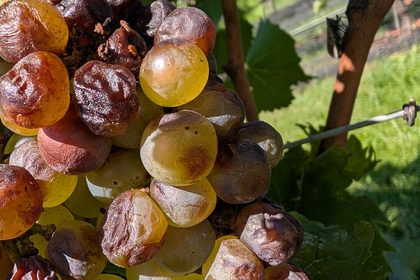
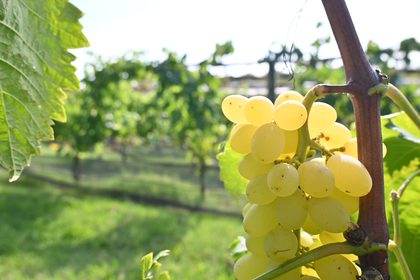
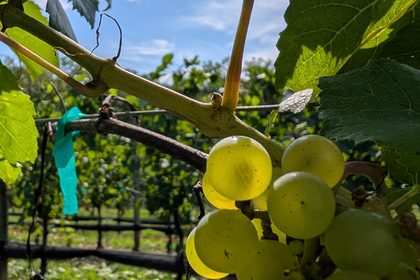
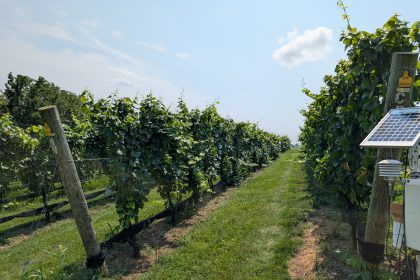
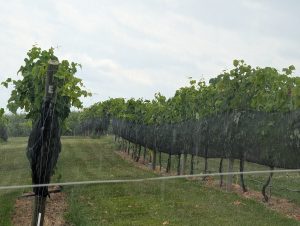
Many Chardonnay, Chardonel, and Vidal clusters are getting soft and approaching veraison. Some others, e.g., Frontenac and many table grapes, are at different stages of veraison.
Grape Disease Risks: 7/22-7/29/2026
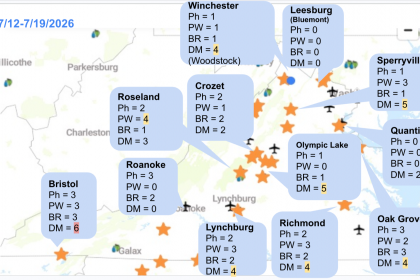
NEWA is an Agricultural Weather Station Network, and we are part of the team. Here is a snapshot from last week showing the number of days with risk for each disease: Ph = Phomopsis, PW = Powdery mildew, BR = Black rot, and DM = Downy mildew. N/A means there is no data or issues with the NEWA. I am waiting to hear back from the weather station company about fixing the one in Stafford. Note: Since we are out of the critical period for black rot and Phomopsis, you can ignore them. Note 2: I moved some stations with data transmission issues.
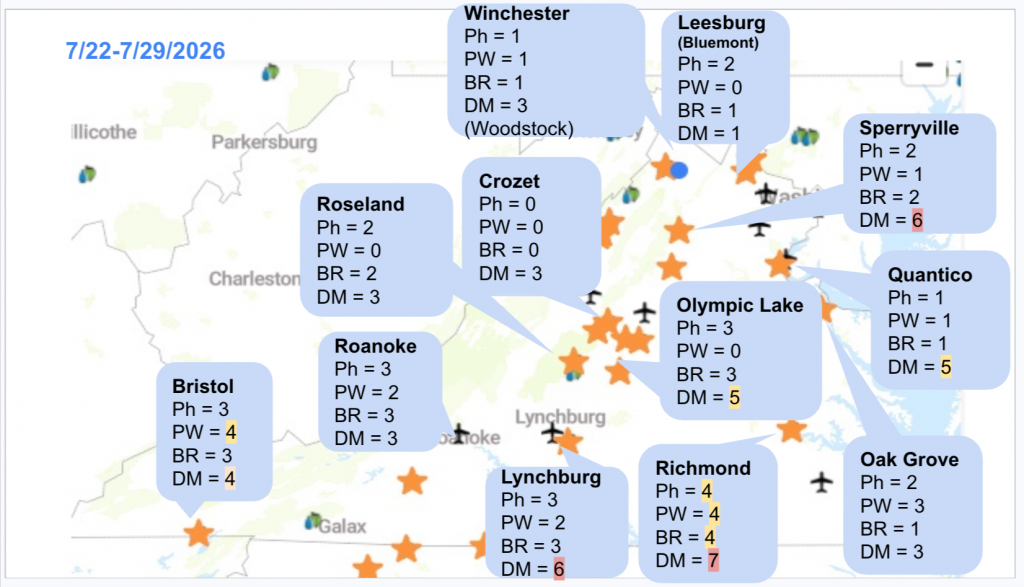
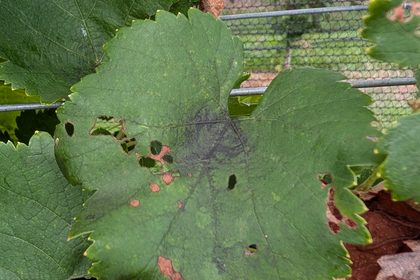
There were more than four of eight days with a risk of downy mildew infection in many locations in central to south VA. As we discussed in the previous virtual vineyard meetings, we still need to maintain our vines to ensure healthy canopies that support bud formation for next year, cane or spur selection, and winter survival. Speaking of the meeting, our next monthly Virtual Viticulture meeting is scheduled for next Thursday (8/6) at 1 PM. Please join us!
Downy mildew forecast

Please click the table above to enlarge. Some locations in central VA are looking at more than a few days with high risk. I hope you can find a time to protect your vines before these events.
The downy mildew forecasting effort is supported by the Virginia Wine Board.
Seasonal Grape Disease Management Reminders: Veraison to Harvest
At this point, our focus will be on downy mildew, ripe rot, sour rot, and Botrytis. Please refer to our Pest Management Guides for specific fungicide recommendations.
Downy mildew
I have used several copper formulations (FRAC M1) in the past years, and they worked very well against downy mildew. Many newer formulations are less likely to cause phytotoxicity, even when applied to a copper-sensitive cultivar. However, many winemakers are concerned about the use of copper and its negative impact during fermentation. The same is true for captan (FRAC M4); thus, please make sure to communicate with your winemaker about when to stop applying copper or captan. Typically, people stop using them ~ 3-4 weeks before harvest.
Other options for downy mildew are Ranman (FRAC 21, 30-day PHI), Revus/Forum (FRAC 40, 14-day PHI, but the risk of resistance is high), Zampro (FRAC 40 plus 45, 14-day PHI, note that one of the components is the same as Revus), and phos acid (FRAC P07, 0-day PHI). A phos acid material may cause phytotoxicity if you apply at a higher-than-recommended rate or mix it with copper. When we tested combinations of copper and phos acid, the results were inconsistent, but we observed increased phytotoxicity; thus, I generally don’t recommend using them together. If you are interested in mixing them, please get in touch with me so that we can discuss some ideas.
Another potential option is biopesticides. Based on our recent trials, Lifegard (FRAC P6), Howler EVO (FRAC BM02), and Zonix (FRAC NC) provided some level of downy mildew suppression. I would not use them as a stand-alone material, but they could be good tank-mix options (when environmental conditions are conducive) or rotation options (when the risk of infection is low). For Howler EVO, we had better results with a 2.5 lb/A rate.
Botrytis gray mold
The best management practice is canopy management. The Botrytis pathogen thrives in high humidity; thus, a poorly managed canopy that traps moisture will support its growth. This pathogen also requires wounds to develop spores; thus, grape berry moth and other insects, as well as birds, need to be managed.
The timing of late-season applications is at bunch closure and at veraison. There are many Botrytis materials such as Rovral and Meteor (FRAC 2), Elevate (FRAC 17), Vangard and Scala (FRAC 9), Luna Experience (FRAC 7 plus 3), Kenja (FRAC 7), Miravis Prime (FRAC 7 plus 12), Switch (FRAC 9 plus 12), etc. Botrytis pathogen is well known for its ability to develop fungicide resistance; therefore, please rotate FRAC codes and add either copper (M1) or captan (M4) to the mix.
QoI fungicides (FRAC 11) are no longer an effective material for us due to the development of QoI-resistant Botrytis isolates throughout Virginia. Pristine (FRAC 11 plus 7) has also been compromised.
Ripe rot
At this point of the season, captan (FRAC M4) plus Switch (FRAC 9 plus 12) fungicides are good options. In addition, we found that QoI (Strobirulin, FRAC 11), copper (FRAC M1), tebuconazole (FRAC 3), Aprovia (FRAC 7, note that it has a 42-day PHI), Howler EVO (FRAC BM02), and Ph-D (FRAC 19) are somewhat effective. However, none of these materials consistently provided satisfactory suppression of ripe rot when applied by themselves in a series of field studies. Thus, please mix two FRAC codes, especially if you have had issues with ripe rot in the past. Applications will be timed to veraison, with an additional application in 2-3 weeks for late-season cultivars.
Sour rot
A tank mix of the insecticide zeta-cypermethrin (Mustang Maxx, IRAC 3A) and the antimicrobial hydrogen dioxide (OxiDate 5.0, FRAC NC) at 15 Brix to suppress the fruit fly population is the key. Two applications in 7 to 10 days are sufficient. In NY, there are reports of Mustang Maxx-resistant fruit flies; thus, please do not overuse it. You may need to revisit your SLF management schedule to hit two targets in one shot. For options beyond Mustang Maxx, please refer to our Pest Management Guides. If you prefer materials other than OxiDate, Switch and Howler Evo showed some efficacy in our trials.
Bitter rot
If you have had a history of bitter rot, captan or QoI fungicide at veraison is often recommended.
Powdery mildew
It won’t affect berries, but it may impact shoots, leaves, and rachis. You may not need to make powdery mildew-specific sprays, but make sure to include a material that controls powdery mildew in your tank mix [e.g., copper (FRAC M1), sulfur (FRAC M2), many of the Botrytis and ripe rot materials, and Torino (FRAC U6), Quintec (FRAC 13, PHI=21), etc.].
List of short-PHI materials
As the season approaches harvest, you need to keep an eye on the Pre-Harvest Interval (PHI). Please see the list below for some options.