Vine status
Unfortunately, many of our vines were affected by the frost event yesterday. I have heard from Northern VA, the Shenandoah Valley, and Central VA, with varying degrees of loss. I lost about 80% of the Chardonnay shoots, about 50% of the Chambourcin and Chardonel, and everything in between.
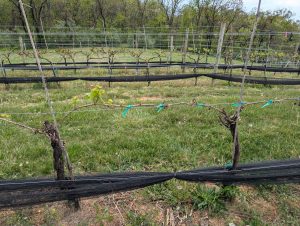
Disease Management After a Frost Event
Here are some disease management tips for dealing with frost-damaged vines, especially if your vines have shoots with several to many leaves open.
- Minor damage: E.g., < 15% of shoots affected.
- You probably do not need to alter your spray schedule.
- Moderate damage: E.g., 20-50% sporadic damage throughout a block. Some shoots are heavily damaged, but others are OK.
- You may keep your regular spray schedule. If we have an extensive rain event(s), there is some risk of Botrytis infection on the damaged shoots. This pathogen can produce spores on dead tissues. If you are concerned about a potential Botrytis infection (i.e., you have a Botrytis-prone cultivar and the weather forecast indicates a large rain event is coming soon), you may want to use either captan or copper instead of mancozeb for the next spray, since both have some efficacy against Botrytis.
- If you keep using either captan or copper as one of your backbone materials, please keep in mind that you need to add a QoI (i.e., strobilurin) or DMI (i.e., sterol inhibitor) for black rot management when we get close to blooming time because these two materials won’t work against black rot.
- In addition, it is probably a good idea to plan for good protection against Botrytis at bloom. In addition to the risk of Botrytis infection on dead shoots, inflorescences on shoots from the secondary buds may make the blooming period last longer than usual.
- E.g., you can use two Botrytis materials with different FRAC groups to protect flowers; maybe use one group at trace bloom and the second at 50% bloom. Plus, make sure to mix a Botrytis material with either captan or fixed copper for the fungicide resistance management.
- Also, you probably need to spend more time on canopy management to avoid a crowded canopy due to extensive lateral shoot development from the damaged shoots.
- As usual, the risk of Botrytis depends on the weather conditions. As of today (4/22/2026), the forecast for northern VA calls for several rain events over the next 10 days. We are expecting days near 80F in the next two days, so I hope the damaged shoots desiccate soon so we don’t need to worry about Botrytis too much. We will see…
- You may keep your regular spray schedule. If we have an extensive rain event(s), there is some risk of Botrytis infection on the damaged shoots. This pathogen can produce spores on dead tissues. If you are concerned about a potential Botrytis infection (i.e., you have a Botrytis-prone cultivar and the weather forecast indicates a large rain event is coming soon), you may want to use either captan or copper instead of mancozeb for the next spray, since both have some efficacy against Botrytis.
- Severe damage: widespread and extensive. E.g., >50%
- If you think there is a chance of having fruits, please see the comment above. You will most likely have more dead tissues remaining in the canopy; thus, the risk of Botrytis can be high. You do not need to remove the dead tissues, as they will be detached from the shoots sooner or later.
- Whether you can expect fruit or not depends on the location of the damage and other factors. E.g., If you see more damage on the upper part of the shoots and clusters/inflorescences seem to be intact, you may get lucky, but I must say that the damage on the inflorescence is very difficult to see.
- Even if you think it will be a total loss (i.e., shoots are dead to the base), you still need to protect your vines.
- Once shoots start to develop from the secondary buds, you need to protect them.
- If you expect fruitful secondary buds, I would recommend using captan or copper for now to avoid exceeding the seasonal limit for mancozeb applications (19.2 lb a.i./acre/year). Once you see shoots, you can switch back to mancozeb.
- If you are not planning to grow any crops, you can adopt a lean disease management program. E.g. use mancozeb plus sulfur, or captan plus sulfur, or fixed copper for the rest of the season. (plus you do not need to spray for grape berry moth or rots)
- Spraying every 10 to 14 days may be enough, but it also depends on the weather. If there are many rain events, you may need to either shorten the spray interval or add a phosphorous acid product or another downy mildew material. (Note: a phos acid and a copper may cause phytotoxicity.)
- You do not need to worry about the 66-day PHI of mancozeb, as you do not have a harvest; thus, you can use it late in the season. However, keep an eye on the limit for total mancozeb used. Please see the label for your product to make sure.
- Once shoots start to develop from the secondary buds, you need to protect them.
- If you think there is a chance of having fruits, please see the comment above. You will most likely have more dead tissues remaining in the canopy; thus, the risk of Botrytis can be high. You do not need to remove the dead tissues, as they will be detached from the shoots sooner or later.
I can only cover potential disease management, and I understand that there is more to it. For more information on vine management after a frost event, please see the links below.
- https://extension.umd.edu/resource/grapevine-frost-damage-ii-compensation-management-and-potential-options/
- https://ucanr.edu/site/ucce-central-sierra-agriculture/frost-recovery
- https://viticulture.uga.edu/files/2020/04/Grapes.-frost-damaged-vines-4.15.20.pdf
Disease risks
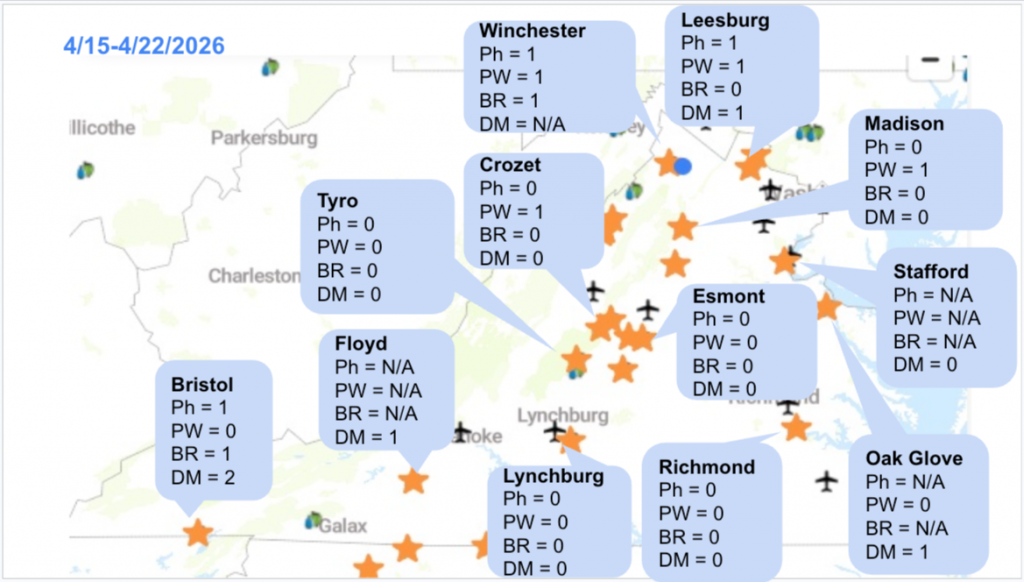
NEWA is an Agricultural Weather Station Network, and we are part of the team. Here is a snapshot from the last week, showing the number of days with the risk of each disease: Ph = Phomopsis, PW = Powdery mildew, BR = Black rot, and DM = Downy mildew. N/A means there is no data or issues with the NEWA. I am waiting to hear back from the weather station company about fixing the one in Stafford.
Since it has been a dry season, risks of major grape diseases are low in the last week.
Downy mildew forecast

It looks like the model is calling for downy mildew infection events next week. As usual, prevention is the best approach. Please refer to my previous post about downy mildew management.
The downy mildew forecasting effort is supported by the Virginia Wine Board.

This Post Has 5 Comments